
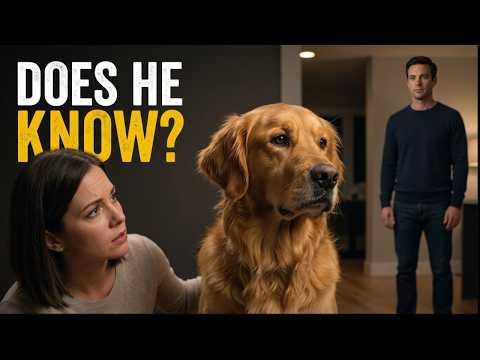
Video
Inside the Mind of Your Dog What Are They Really Thinking
An educational video about how dogs respond to reliable and unreliable human information, without assuming they understand deception like people.
Duration: 3:44
Article
Dogs can respond to human gestures and attention, but a successful response does not reveal a complete private thought. Separate what happened from your explanation.
Your dog glances at the lead, walks to the door and looks back at you. The moment invites a translation: they know you are planning a walk. Perhaps the sequence is familiar. Perhaps your hand moved toward the lead before you noticed. The interesting question is not whether dogs are clever enough to deserve our affection. It is how much the visible evidence allows us to conclude.
Canine cognition research investigates abilities such as learning, attention and choosing between alternatives. It does not give an owner a transcript of a dog's thoughts. A useful explanation can acknowledge a real skill while remaining careful about the mental story attached to it.
In a 2009 review, Pamela Reid examined dogs' success at using human communicative gestures to locate hidden food. She considered several explanations, including opportunities to learn, effects of domestication, broader problem-solving abilities and sensitivity to behavior that helps a social scavenger find resources. The review did not reduce every successful response to one mechanism. [S1]
That distinction matters in an ordinary home. Suppose a dog approaches the treat cupboard when you point. Their correct choice establishes that your gesture was useful in that situation. It does not establish whether they understood your intention, recognized a familiar arm movement, followed the direction of your body, or combined several clues. Naming those alternatives is a way to take the response seriously without claiming more than it demonstrates.
Udell, Dorey and Wynne's 2011 research tested responses to human attentional cues. As described in a contemporaneous methodological commentary, wolves, shelter dogs and pet dogs preferred begging from a person facing them rather than one with their back turned. Tests also changed whether a person's eyes were obscured by objects. The groups did not respond identically to every version. [S2, S3]
The original authors reported that wolves could respond to human attention under some conditions and that dogs were more sensitive to cues familiar from their home environments. Roberts and Macpherson cautioned that prior learning complicated using the task to decide between explanations about domestication or theory of mind. A preference in a begging task is evidence about that task, not a demonstration of unrestricted mind-reading. [S2, S3]
Consider an illustrative household sequence: you finish a call, close your laptop and reach for your shoes. Your dog waits near the door before you say anything about a walk. One possible explanation is that the sequence has often preceded going outside. Another is that a particular sound or movement is doing most of the work. You do not have to decide immediately which explanation is correct.
Write the order down once: laptop closed, shoes moved, dog approached the door. On later occasions, notice whether the response still occurs when the sequence changes naturally. Avoid repeatedly teasing the dog with false starts. A useful observation should improve your understanding of daily life, rather than turn the relationship into a series of tricks designed to catch them out.
Imagine a second example: a dog looks toward you when a toy rolls under furniture. The look could be related to a history of people retrieving toys. It could also occur while the dog alternates attention between the toy and the room. Describing the sequence gives you a practical question: does looking toward a person usually precede help in this setting? Saying the dog has deliberately explained the entire problem adds an interpretation that the observation alone cannot settle.
You can still help. Retrieve the toy if it is safe, or arrange play so it is less likely to disappear underneath the sofa. The practical response does not require a verdict about the exact thought involved. Similarly, when the treat cupboard attracts attention, a clearer routine may be more helpful than debating whether your dog has planned the afternoon.
If your dog does not follow a gesture on one occasion, start with modest questions. Could they see your hand? Were you pointing toward a familiar location? Was another event competing for attention? These are possible influences to consider, not a diagnosis of why the response failed. A confusing setup can make an ability difficult to observe.
Keep your description separate from your conclusion: 'looked at my hand, then walked away' records more than 'did not understand me.' Over time, a few specific notes can reveal where communication is easiest and where you need to make it clearer. The goal is a workable relationship with this dog, not a score that compares them with every dog on the internet.
You can appreciate your dog's flexibility without inventing an inner monologue. The strongest question is often smaller and more useful: what information was available, what did the dog do with it, and what could make the next interaction easier?
For a concise way to record your own observations, use the Dog Behavior Context Checklist.
[S1] Reid, P. J. (2009). Adapting to the human world: dogs' responsiveness to our social cues. Behavioural Processes, 80(3), 325–333. doi:10.1016/j.beproc.2008.11.002.
[S2] Udell, M. A. R., Dorey, N. R., & Wynne, C. D. L. (2011). Can your dog read your mind? Understanding the causes of canine perspective taking. Learning & Behavior, 39, 289–302. doi:10.3758/s13420-011-0034-6.
[S3] Roberts, W. A., & Macpherson, K. (2011). Theory of mind in dogs: is the perspective-taking task a good test? Learning & Behavior, 39, 303–305. doi:10.3758/s13420-011-0037-3.
Reid, P. J. (2009). Adapting to the human world: dogs' responsiveness to our social cues. Behavioural Processes, 80(3), 325–333. doi:10.1016/j.beproc.2008.11.002., See linked original source, accessed 2026-10-05
S1
Open source linkUdell, M. A. R., Dorey, N. R., & Wynne, C. D. L. (2011). Can your dog read your mind? Understanding the causes of canine perspective taking. Learning & Behavior, 39, 289–302. doi:10.3758/s13420-011-0034-6., See linked original source, accessed 2026-10-05
S2
Open source linkRoberts, W. A., & Macpherson, K. (2011). Theory of mind in dogs: is the perspective-taking task a good test? Learning & Behavior, 39, 303–305. doi:10.3758/s13420-011-0037-3., See linked original source, accessed 2026-10-05
S3
Open source linkVideo
An educational video about how dogs respond to reliable and unreliable human information, without assuming they understand deception like people.
Duration: 3:44