
Video
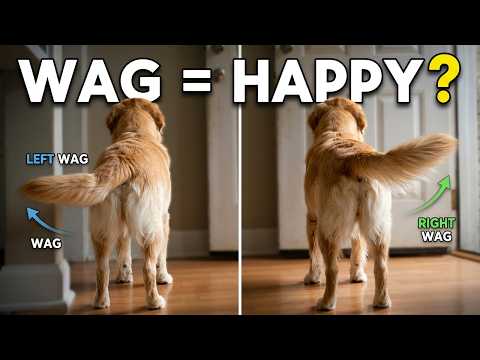
Left vs Right Tail Wagging Here's What Scientists Found
A public DogMind Journal video about why tail wagging should not be interpreted as a simple happiness signal and why left/right tail-wagging research should be handled...
Duration: 5:30
Article
Tail-wagging studies measured a difference in movement to each side, not a simple emotional switch. Left and right refer to the wagging dog's body, and context still matters.
A wagging tail is easy to notice and surprisingly easy to oversimplify. Add the possibility of a left or right bias, and it can sound like dogs carry an emotional indicator we simply need to decode. The actual research is more interesting: scientists measured patterns under controlled conditions and tested whether other dogs responded to them.
To understand those findings, first clarify what was measured. A side bias concerns the relative extent of movement towards each side of the body. It does not mean a tail moves only left or only right, and it does not give an observer a universal translation for one wag.
In this research, directions are defined from the wagging dog's perspective. Imagine standing behind the dog and facing the same way: the dog's left is on your left. If you face the dog, its left appears on your right. A mirrored phone image can reverse what you think you are seeing. Establish the orientation before describing a recorded movement.
The distinction also concerns amplitude, or how far the tail sweeps. In the 2007 experiment, researchers compared the maximum angles reached on either side of the dog's body using recorded footage. A quick glance at the tail tip moving left is not an equivalent measurement of the whole pattern. [S1]
Quaranta, Siniscalchi and Vallortigara tested 30 pet dogs in 2007. Dogs viewed their owner, an unfamiliar person, a cat, an unfamiliar dog described in the paper as dominant, or an opening with no visual stimulus. Recorded tail movements showed a right-sided amplitude bias with the owner and unfamiliar person, and a smaller right bias with the cat. A left bias appeared both with the unfamiliar dog and in the no-stimulus condition. These results linked side differences to experimental conditions; they do not support an unconditional rule that every left-biased wag means a specific negative feeling. [S1]
In 2013, Siniscalchi and colleagues investigated dogs watching moving video images of another dog with predominantly left- or right-biased wagging. Observers showed higher cardiac activity and higher scores of anxious behaviour when viewing left-biased rather than right-biased wagging. The experiment supports sensitivity to the asymmetry. It measured responses to controlled images; it did not validate a human decision rule for approaching an unfamiliar live dog, or establish that dogs deliberately choose a wag direction to send a message. [S2]
This is a useful distinction between producing a pattern and responding to one. The first study measured tail movement during different situations. The second asked what happened to dogs observing contrasting movements. Neither requires the everyday claim that you can read an individual dog's exact feelings from tail direction alone.
On a pavement, two dogs may be moving, turning or pulling in different directions. Their handlers may also be shortening leads or changing distance. Your viewing angle shifts. Even before discussing emotion, those conditions make a side comparison less reliable than a recorded measurement with a clear body axis.
The practical decision is usually broader: should the greeting happen, continue or end? A perceived rightward bias should not override a dog turning away, difficulty maintaining space, or a handler asking you to keep your distance. You can decline a greeting without interpreting every movement, and a tail wag does not oblige either dog to interact.
Nor should an uncertain leftward sweep turn a dog into a presumed threat. If you cannot establish a clear pattern, report that uncertainty. The point of learning about asymmetry is to become more attentive to detail, not more confident in a shortcut that the experiment did not test.
If you already have footage of a relaxed, ordinary interaction, note where the dog is facing and whether the image is mirrored. Look at several sweeps rather than freezing one dramatic frame. Is the body turning at the same time? Is part of the tail hidden? Those details may make a direction judgment impossible, which is a valid conclusion.
Describe the rest of the event separately: who approached, whether the dog moved closer or farther away, and how the interaction ended. You can write 'wagging while stepping back' without choosing an emotion label. Comparing the sequence with another ordinary recording may reveal a question worth exploring, but it remains an observation of this dog rather than a replication of the published study.
Do not provoke a reaction, present an unfamiliar animal or move into close range to obtain better footage. Observation is useful only if collecting it does not make the situation harder. Tail shape, visibility and camera position can also limit what you can assess; there is no obligation to classify every wag.
Tail asymmetry adds a dimension to the study of canine behaviour. In daily life, it should encourage a more careful description: which dog, which perspective, what pattern, and what situation? Keep your decisions tied to the whole interaction and the space each dog needs. A measured side difference is meaningful research; one uncertain glance is still only one uncertain glance.
For a concise way to record your own observations, use the Dog Behavior Context Checklist.
[S1] Quaranta, A., Siniscalchi, M., & Vallortigara, G. (2007). Asymmetric tail-wagging responses by dogs to different emotive stimuli. Current Biology, 17(6), R199–R201. DOI: 10.1016/j.cub.2007.02.008.
[S2] Siniscalchi, M., Lusito, R., Vallortigara, G., & Quaranta, A. (2013). Seeing left- or right-asymmetric tail wagging produces different emotional responses in dogs. Current Biology, 23(22), 2279–2282. DOI: 10.1016/j.cub.2013.09.027.
Asymmetric Tail-Wagging Responses by Dogs to Different Emotive Stimuli, Angelo Quaranta, Marcello Siniscalchi, Giorgio Vallortigara, Current Biology (2007-01-01) DOI: 10.1016/j.cub.2007.02.008, accessed 2026-07-15
S1
Open source linkSiniscalchi, M., Lusito, R., Vallortigara, G., & Quaranta, A. (2013). Seeing left- or right-asymmetric tail wagging produces different emotional responses in dogs. Current Biology, 23(22), 2279–2282. DOI: 10.1016/j.cub.2013.09.027., See linked original source, accessed 2026-10-05
S2
Open source linkVideo
A public DogMind Journal video about why tail wagging should not be interpreted as a simple happiness signal and why left/right tail-wagging research should be handled...
Duration: 5:30