
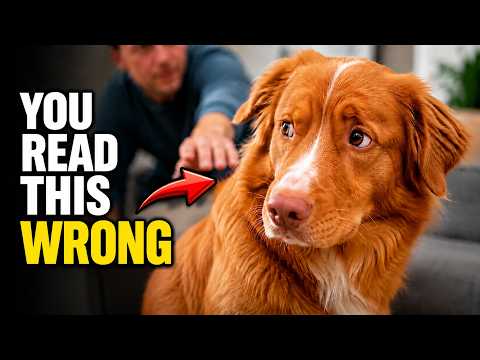
Video
Your Dog Does These 3 Things When Something Feels Off
A public DogMind Journal video about yawning, lip licking, freezing, and why one visible behavior is not enough for interpretation.
Duration: 4:56
Article
Yawning, lip licking and freezing can be worth noticing. Learn how to describe the surrounding situation before assigning any one meaning.
Yawning, lip licking and freezing are the three behaviors named in the companion video. The video cautions that a yawn is not always tiredness, lip licking is not always hunger or affection, and a quiet frozen dog is not always calm.
Those observations are a starting point, not a verdict. Look at what happened before, what the dog's whole body is doing and what happens after. A careful description can help you decide whether to make the situation easier or discuss a persistent change with a veterinarian.
A yawn may occur after rest or during an interaction; a lip lick may occur around food or in other circumstances; and stillness can be loose or tense. The same visible behavior can occur in more than one situation. Notice posture, movement, distance and the change that follows rather than assigning one meaning from a single moment.
If a dog becomes still during an approach, pause the interaction and give them room to choose distance. If a behavior is new, persistent or occurs alongside other changes, share the full pattern with a veterinarian rather than trying to diagnose it from a list of signals.
A baseline is a description of what is usual for this individual under ordinary circumstances. Think about familiar activities: greeting household members, moving between resting places, joining a walk or responding when a toy appears. Different dogs will show interest differently, so comparing yours with a particularly active neighbor's dog may tell you little.
Our Baseline Changes guide explains why an individual's pattern matters. The goal is not to demand the same behavior every day. It is to recognize a difference significant enough to deserve a closer look.
For an illustrative example, replace 'my dog has become difficult' with 'they stopped at the bottom of the stairs on two evenings, although they normally go upstairs with us.' The second version records a change in a specific task. It does not decide whether movement, the surface, the upstairs environment or something else explains it.
Likewise, 'they no longer like visitors' is broader than 'during two visits they stayed behind the chair instead of approaching.' The narrower description leaves useful questions open. Were the visitors new? Was the room busier? Did the dog behave similarly when no guests were present? Those details help you separate an event from a conclusion.
In a clinical review, Mills and colleagues discuss how painful conditions can contribute to behavior problems. The paper draws on referred cases and clinical examples; it is not a survey that allows an owner to calculate the chance that any particular behavior is caused by pain. Its relevant message is that physical discomfort should not be excluded simply because a problem first appears behavioral. [S1]
That does not mean every quiet afternoon is illness. It means you should not assume a new reluctance is stubbornness or a changed social preference without considering health. The RSPCA recommends veterinary advice when a dog's behavior changes or regular signs of distress appear. [S2] Observation supports this step rather than postponing it until an owner has identified the cause.
A record becomes more useful when it includes ordinary occasions on which the behavior is absent. A dog might hesitate near one doorway but move readily elsewhere. They might avoid one handling activity yet settle normally after it stops. These contrasts can help you describe where the change occurs; they do not diagnose its mechanism.
Do not repeatedly ask for a movement or interaction that the dog is avoiding in order to collect more examples. Instead, describe naturally occurring events and adjust the immediate situation so the dog has an easier option. If a change seems linked to handling, leave the assessment of discomfort and the next steps to the veterinarian.
A practical record can include when you first noticed the difference, what the dog normally does, what happened this time and whether it happened again. Add relevant changes to the household routine or environment. If you already have a short video captured without provoking the behavior, it may help explain the observation.
A note such as 'remained downstairs after our usual evening cue on Monday and Wednesday; came upstairs normally on Tuesday' is easier to evaluate than 'sometimes acts strange.' If an opportunity did not arise, mark that too. Absence of a recorded event is not proof that the behavior has disappeared.
Dogs Trust recommends giving a dog space and choice when an interaction appears overwhelming. [S3] That is a reasonable immediate adjustment; it is not a substitute for investigating a persistent change. A dog that repeatedly avoids a familiar activity needs more than a new label or another attempt to persuade them.
Tell your veterinarian about the observations that concern you and follow their advice on urgency and assessment. You do not need to complete a diary before making contact. The point of a record is to make the conversation clearer, not to create a waiting period or to diagnose your dog yourself.
Good observation can change your original interpretation. A pattern you first associated with one visitor may also occur when the room is empty; an apparent preference may instead follow a change in routine. Keep the record factual enough that those discoveries can update it. For a concise place to start, use the Dog Behavior Context Checklist.
[S1] Mills DS et al. 2020. Pain and Problem Behavior in Cats and Dogs. Animals 10(2):318. Clinical review. DOI 10.3390/ani10020318.
[S2] RSPCA. Understanding your dog's behaviour. Professional welfare guidance. Accessed 5 October 2026.
[S3] Dogs Trust. Why dogs get scared or frustrated and how to help them. Professional behavior guidance. Accessed 5 October 2026.
Mills DS et al. 2020. Pain and Problem Behavior in Cats and Dogs. Animals 10(2):318. Clinical review. DOI 10.3390/ani10020318., See linked original source, accessed 2026-10-05
S1
Open source linkUnderstanding your dog's behaviour, RSPCA, accessed 2026-10-05
S2
Open source linkDogs Trust. Why dogs get scared or frustrated and how to help them. Professional behavior guidance. Accessed 5 October 2026., See linked original source, accessed 2026-10-05
S3
Open source linkVideo
A public DogMind Journal video about yawning, lip licking, freezing, and why one visible behavior is not enough for interpretation.
Duration: 4:56